// architecture diagram · v2026.11
Giuliano
Antonanzas
Tech Lead · Full Stack · IA & AWS
- Entre Ríos, Argentina · GMT-3
- Remote
- In the industry since 2021
- Native Spanish · working English
- Open to Tech Lead · Senior Full Stack
Teams, clients and ideas go in. What comes out: products in production, people trained for the industry and systems that run cheap. In between: five years at Crombie, first as a developer and then as Tech Lead, two editions of Escuelita and products of my own. This is the diagram; the detail is on each page.
01 · hi
I code, I lead and I teach. I got there in that order, and I still do all three.
I joined Crombie in 2021 to write code. Two years later they gave me a team, and since then I've led five projects for clients in the US and Argentina: fintech, logistics, events, IoT. Alongside that I directed Escuelita, where we trained people with no experience and put them on real projects.
Today I'm still at Crombie as a developer: NFTYDoor's backend and, this year, the citizen app of the City of Santa Fe. Outside work I build my own products, with AI and on AWS. I believe one person with good tools now does what five used to, and I like being that person.
- teams_led
- 5
- max_team_size
- 16
- client_projects
- 7
- escuelita_editions
- 2
- aws_certifications
- 2
- own_products_on_aws
- 3
stack · what I use every day
02 · git log --graph --all
The journey, in three branches
- main · Crombie
- escuelita
- own
- 2021
Recreo
I join Crombie as a Full Stack developer to build Recreo, the events app and website for the province of Buenos Aires. First sign that I like organising things, not just coding them.
Read more → - Jan 2023
Tech Lead · Datision
My first team: five people and an AI-powered IoT project that was already in trouble. We stabilised it and met the goals.
Read more → - Feb 2024 · merge escuelita
Skylightlending
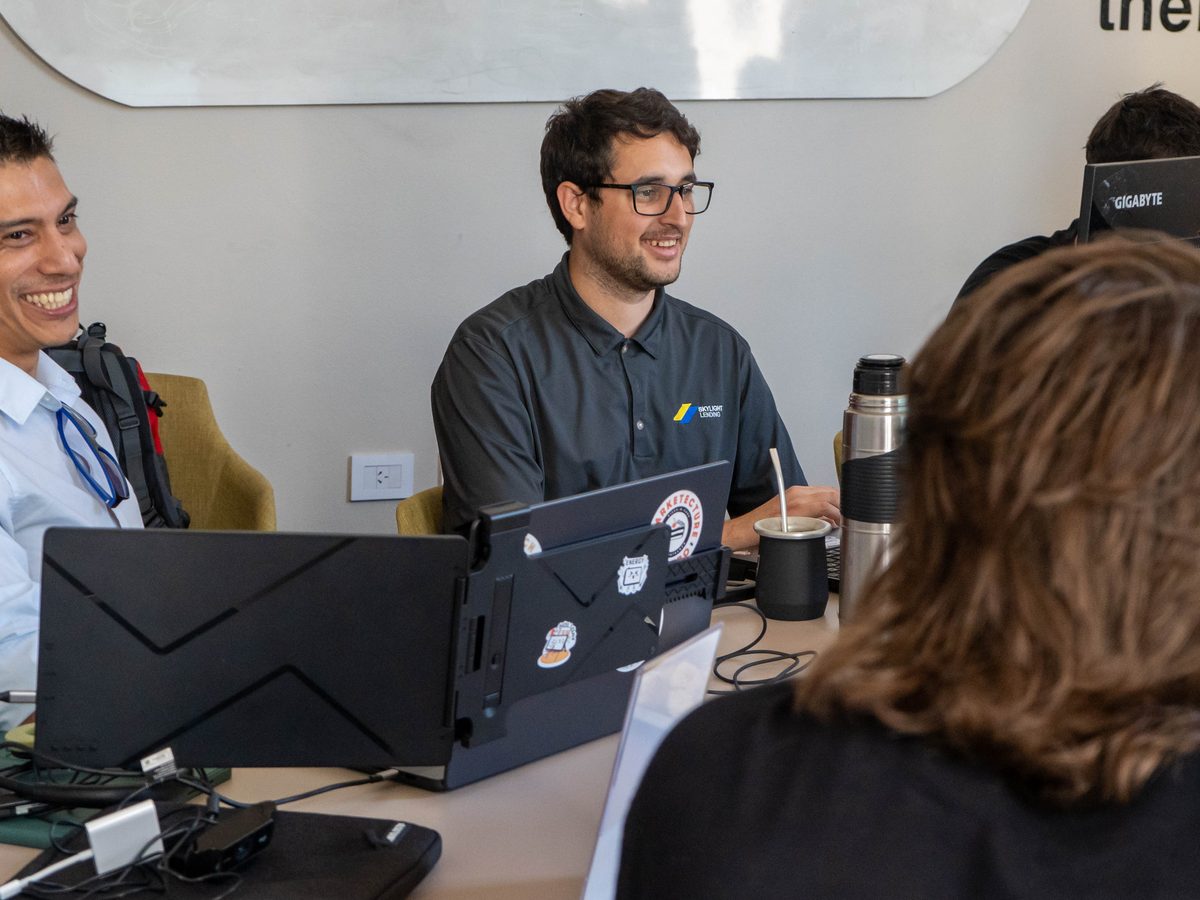
Back at NFTYDoor, now as Tech Lead of 16 people, for its solar lending platform. I stop the turnover, split the infrastructure and migrate it to SST.
Read more → - 2025
Seguridar
I start my own product: agents, vision engine, API and infrastructure, designed and built by me end to end.
Read more → - HEAD · today
Developer at NFTYDoor
The product whose foundations I helped build in 2022 has grown, and that work is why they called me back. Today I develop its backend: identity, credit and co-borrowers. The own branch stays open.
Read more →
03 · leading teams
A Tech Lead has three jobs.
Almost no project came to me under ideal conditions: teams with turnover, legacy systems, clients nobody had met, impossible deadlines. What I learned fits in a short runbook.
- step 1
The team is doing well
One-on-ones, feedback and the spotlight for whoever wants it. And hard decisions when someone no longer contributes, or when someone who does is about to be taken off the project.
- step 2
The client knows what's going on
Environments where every delivery can be seen, measurable sprints, and meetings where we show, listen and plan. In English when needed.
- step 3
The code ships
Code reviews, automated deploys and infrastructure nobody is afraid of. And when something is missing, I sit down and build it.
case · Skylightlending · NFTYDoor · 2024 – today · 16 people
The project where nobody had met the client.
NFTYDoor's solar-panel lending platform. I arrived at a team of 16 with sky-high turnover; I stopped the turnover, split the repository and infrastructure away from the main product and migrated it to AWS Serverless with SST, at lower cost.
See the project →- Fulter · Sep 2023 – Feb 2024
A shipment platform for a logistics operator, built on top of its existing system. We understood the client's database better than the client did, published the apps in the stores, and the project continued after the MVP. - Skedules Live · Jun – Sep 2023
Events and calendar platform for an international client. Scrum process, develop, staging and production environments and automated deploys, all from scratch. - Qwiky · Apr – Jun 2023
Post recommendations, scalability and an iOS/Android app with React Native and NestJS, with a team of seven. - Datision · Jan – Apr 2023
Alert platform for AI-powered IoT devices. I joined a struggling team of five, we stabilised it and delivered what had been promised.
04 · escuelita · oct 2022 – Dec 2023
From zero to a real project, twice.
Escuelita is Crombie's talent incubator: we look for motivated people with no experience, teach them the frameworks the industry uses and bring them into real projects. I directed the first two editions. Of everything I've done at Crombie, it's what I'm proudest of.
- editions
- 2
- hours a week
- 8
- months
- 14
- starting point
- no experience
- finish line
- real project
05 · what I'm building
Own products, each with its architecture.
I build them outside work, they run on AWS and the bill stays small.

own product · 2025 – today
Seguridar
Peace of mind without surveillance.
So a parent finds out in time if their kid is getting into online betting or other risks, without going through their phone. Agents, vision engine, API, dashboard and infrastructure, designed and built end to end.
- Windows · Android agents
- S3
- Vision engine · CLIP
- NestJS API
- PostgreSQL
- Parent dashboard · Next.js
- SMS · email
own product · 2026
Constelaciones Familiares
My mother's practice website, rebuilt from scratch.
Calendar with online sign-up, availability-based appointments, admin panel, articles and SEO. Next.js on AWS with SST: almost all of it fits in the free tier.
- GitHub Actions
- SST · OpenNext
- Lambda + CloudFront
- DynamoDB
own product · 2026
IA-Trader
Does buying the dip on the S&P 500 pay off? A bot puts it to the test.
Six portfolios with virtual credits compete against the index: a backtest since 2007 and checks every 5 minutes during market hours. Runs on AWS for under 1 USD a month.
- EventBridge
- Lambda · Python
- DynamoDB · S3
- API Gateway
- Browser
05b · custom software for businesses
Three real-world business problems, solved with software that works.
This is how I work with businesses: I understand the problem, build a working solution around their own formats (Excel, PDF, photos, WhatsApp audio) and bring it to the first meeting already running. Then it gets tuned in a pilot with real data.
Clinics and hospitals · billing
Health-insurer deductions were going unclaimed.
- problem
- Every month the clinic bills hundreds of services and the insurer settles in a PDF full of deductions that have to be found line by line. Between the volume and the rebilling deadlines, part of that money expired unclaimed.
- solution
- A reconciler that matches the billed Excel against the settlement PDF, identifies each deduction with its cause, says which ones can be claimed and by when, and generates the PDF report and the rebilling letters in Word. Plus an aggregated view for the clinics' association, by insurer and by cause, with no patient data.
- outcome
- From days of manual work to minutes: the clinic uploads two files and leaves with the list of what to claim, in which order and with which documents. It all runs in the browser: health data never leaves the clinic. The matching logic is pure, tested code; AI is an optional mode for the cases the rules can't settle.
- Excel + PDF
- Line-by-line matching
- Cause · deadline · docs
- PDF + Word
Road construction · certification
Daily reports came in over WhatsApp and the certificate was built by hand.
- problem
- Foremen send audio and photos from the site; the technical office transcribes them into a spreadsheet and builds the monthly certificate at month end, when it's too late to catch a delay. Price redetermination was calculated separately, at the last minute.
- solution
- A WhatsApp number that understands the report (contract item, quantity, section, crew), asks for photos and location, and confirms it with the foreman. Each confirmed report rolls into the certificate on its own, which flags what the inspector might object to: items over contract, delays against plan, progress without photos. Redetermination computes the factor month by month and marks when to request it.
- outcome
- Progress is visible the same day, not at month end. Certificate and redetermination come out in Excel with the formulas visible, ready to audit. Rules handle most reports; there's an AI mode for the rest.
- WhatsApp · audio
- Structured report
- Monthly certificate
- Redetermination
Utilities cooperative · meters
Readings were typed in the field and the errors showed up on the bill.
- problem
- The meter reader writes it down by hand, the error surfaces when the member disputes the bill, and there's no evidence of what the meter said that day.
- solution
- An app where the reader takes a photo and the reading loads itself: it reads the serial and the counter, validates it against the supply's history (lower reading, rollover, spike, drop, doubtful photo) and, if something doesn't add up, asks for a second photo on the spot. The supervisor watches the route live and exports to the billing system with the photo and its hash as evidence. The same app drafts inspection reports and publishes scheduled outages to every channel from a single entry.
- outcome
- Errors get resolved on the sidewalk, not on the bill. Every reading is stored with photo, date and validation; the OCR runs on the phone without internet.
- Meter photo
- OCR
- Validation vs. history
- Billing system
06 · contact
Let's talk
A team that needs some order, a product you want to build or a system you want to cost less. Open to Tech Lead, Senior Full Stack or DevOps roles (remote) and custom software work.
giulianoantonanzas@gmail.com